Tax Effecting Pass Through Entities
"Why are you putting a tax rate on my pass-through entity in your valuation model?"
It is a question I get asked relatively often. The simple answer is, if you are earning income, you are paying taxes. The more complex is, "Why did you choose that rate?"
If your business is a C Corporation, the federal rate is a flat 21% right now. For a valuation expert, adding a blended state and local tax rate onto the 21% makes for a generally defensible position.
For PTEs, it is not so clear. Our progressive tax rate varies based on each owner's income and marital status. There is also this thing called the 20% Qualified Business Income (QBI) deduction that can lower the rate an owner gets taxed on his business income—but of course there are nuances and exceptions here as well.
Leading practitioners stress that a hypothetical tax (“tax-affecting”) should be applied to PTE earnings to reflect the very real tax burden owners will face and to align with the after-tax nature of market-based valuation metrics.
Recent tax cases (e.g., Kress, 2019 and Pierce, 2025) reopened the door to tax-affecting S-Corp earnings. In the Pierce decision, experts for both sides agreed to apply a hypothetical tax (the court accepted ~26% as reasonable in that instance) to avoid a “mismatch” between pre-tax S-Corp cash flows and after-tax discount rates. Yet even that court cautioned tax-affecting isn’t automatic in all cases, underscoring the need to justify the chosen rate by the facts.
The selected tax rate has a significant impact on valuation. Using the following assumptions, one can see how selecting the right tax rate can impact value.

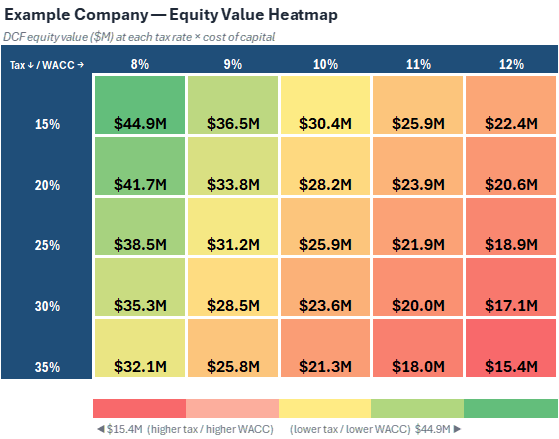
So in true consultant fashion, the answer to my client's question is usually, "it depends on the situation." However, there is more analysis that goes into the fact pattern than just slapping a number down and assuming it is right.